
Home is the Lower River
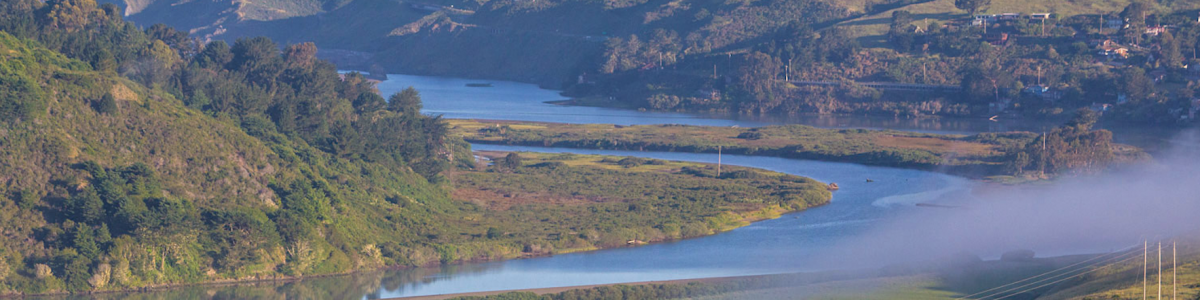
After traveling south for over 80 miles, the Russian River makes a sharp right turn at Forestville and heads west for about 25 miles where it flows into the ocean at the town of Jenner. Mark West Creek and Laguna de Santa Rosa are major watersheds that converge with the Russian River at the river bend.The ambiance of the lower Russian River has changed relatively little in the last forty years. Visitors come here from all over the world to experience our paradise. The waterway is thickly lined with giant redwoods for most of its westerly course, and summer cabins are hidden on hillsides, riverbanks, and in deep interior canyons. About two thirds of the former cabins have been converted to full time use over the last 25 years.
The Russian River used to be one of the three greatest Steelhead fisheries on the North Coast. Fishermen flocked here from far and wide every winter to fish. It is only in the last fifty years, that their numbers have been decimated, and the Endangered Species Act has stepped in to play a major role in river management. It is one of RRWPC's major concerns however, that proposed projects to save the fish may be too little, too late, and may cause more harm to the watershed than bring protections for the fish.
The river also serves as a water supply source for about 600,000 urban dwellers in Sonoma County and Marin, as well as providing a source of water for extensive grape growing activities throughout the region. This has led to more focus on improved conservation, wastewater reuse, and better management of groundwater resources, to name a few. Yet, there is still much to be done.
And there is a dark side to all this. This area of extraordinary natural beauty and extensive natural resources is also extremely fragile. It is subject to large floods, massive slides, falling trees, high water tables, water quality problems, etc. It is concern for this fragility that has motivated RRWPC to devote our life's work over the last 37 years to preservation of the lower Russian River watershed. This website is testimony to that concern and represents our recent work to preserve it from the influences that would turn it into something less than what it is.
RRWPC Newsletter, July 2024: Lower River Septic Meeting
Since 1980, RRWPC has advocated for policies and governmental actions that protect and improve Russian River water quality. We played a major role in the removal of most of Santa Rosa’s wastewater discharges from the Russian River; and we caused a scientific study to be written (Report to Russian River Watershed Protection Committee and City of Santa Rosa by Daniel E. Wickham and Robert W. Rawson: Phosphate Loading and Eutrophication in the Laguna de Santa Rosa: Read More >>RRWPC Newsletter, May 2024: RRCSD, Fee Increase, Special District
Some sad news to report this month, sorry to say, but you need to know the following: Water Agency’s $20M grant application denied for RRCSD pipe & pump station repairs....We learned recently that the results of the income survey supposedly received by all Russian River County Sanitation District (RRCSD) ratepayers, was determined to be just shy of required amount to qualify for funds, as the cutoff was 80% of statewide average income and the District was at 81%. Read More >>RRWPC Newsletter, February 2024: Wastewater...Behind the Scenes
Partial truths equal mistruths as the public is misled and thereby uninformed….Over many years, RRWPC has followed the evolution of numerous Russian River Area programs as they evolved from behind the scenes. The public is generally kept unaware of program details until project plans are almost complete, with only a select few allowed advanced peeks at what is planned. In order to persuade others to support a new program, bits of information that are partially true, but fail to convey Read More >>RRWPC Newsletter, November 2023: Potter Valley and the Water Agency
Potter Valley Project (PVP) on its way out…..Now is a time of major transition in the water resource management field. After completion of a long and laborious public process expected to occur during the next several years by water contractors and users, governmental managers and technicians, fishery advocates, native Americans, and environmentalists, the following issues will hopefully see their way to resolution: changing status of water rights by the State, climate change impacts involving Read More >>RRWPC Newsletter, September 2023: Sewage Spill Penalties
Four years in the making, the ACL is finally here….The ‘Prosecution Team’ of the North Coast Regional Board has finally, after four years, completed their investigation into the enormous February/March, 2019 raw sewage spill by the Russian River County Sanitation District (RRCSD) near the Vacation Beach pump station and Main Lift Staion. These spills are a recurring event spewing thousands of gallons of raw sewage into the river during almost every major flood over 40’. Read More >>>